| |
|
|
| |
|
|
| |
|
SSF Newsletter February 2026
|
| |
|
Gaining Clarity
|
| |
|
Dear Reader
|
| |
|
In the first two months of the year, we have published two spotlights: How Artificial Intelligence Contributes to Effective Sustainable Finance and How Much Change? Addressing Challenges for Investors in Measuring Impact. Taken together, these publications focus on practical solutions to enhance transparency, credibility and efficiency in delivering sustainability outcomes.
In Switzerland, impact investing continues to grow, reaching CHF 228 billion in assets under management according to our Investment Market Study 2025, and expectations around transparency, comparability and accountability are rising just as quickly. Robust impact measurement is no longer a reporting add-on, but a core element of investment discipline and market integrity. Our latest publication, How Much Change?, was developed under the supervision of three members of the Swiss Platform for Impact Investing Executive Board and enriched by input from experts across private equity, private debt, listed equity and data providers. Their insights highlight where current approaches work well, where challenges persist, from data collection and KPI definition to aggregation and attribution, and which practical solutions can strengthen transparency and comparability across the market.
Internationally and within Europe, further initiatives are advancing clarity, around climate adaptation, risk and reporting, underlining the broader momentum towards more robust and decision-useful sustainability information.
We hope this edition offers valuable insights and look forward to continuing the exchange with you.
|
|
| |
|
|
Kind regards,
Veronica Baker
Senior Project Manager – Lead Impact Investing & Nature
|
| |
|
|
|
| |
|
|
| |
| |
| |
|
SSF activities at a glance
|
| |
|
| |
|
Launch of SSF Spotlight "How Much Impact? Addressing Challenges for Investors in Measuring Impact"
|
| |
|
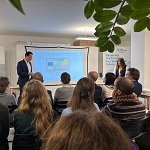
More than 100 participants explored current challenges in measuring social and environmental outcomes in impact investing in the course of the launch webinar of the latest SSF Spotlight on impact measurement, with key insights provided by Veronica Baker (SSF), author of the report. Afterwards three experts in the field provided insights into their challenges related to assessing the impact of their investments.
|
| |
|
|
|
| |
| |
|
Joint SSF/CSVN-Event on Sustainability in Lending in Vezia
|
| |
|
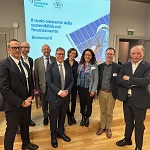
In an event jointly organised by Centro Studi Villa Negroni (CSVN) and SSF with the support of ABT, a focus was put on the growing role of sustainability for the lending business. After a presentation of the results of the Swiss Sustainable Lending Market Study 2025 and insights into current practice, Helen Tschümplerlin Moggi (CSVN) discussed with a panel of experts about the right frameworks for sustainable mortgages and SME lending. Over 90 people joined us in Vezia and contributed to a vivid Q&A session.
|
| |
|
|
|
| |
| |
|
Launch of SSF Spotlight "How Artificial Intelligence contributes to effective Sustainable Finance"
|
| |
|
In this spotlight report, SSF outlines the use of AI for effective sustainable finance along a data-to-decision workflow. The launch webinar illustrated the high interest in the topic with over 150 participating. After walking the audience through the content of the spotlight paper, Romain Leroy-Castillo (SSF) left the floor to two practitioners introducing their use cases at the intersection of AI and sustainable finance.
|
| |
|
|
|
| |
| |
|
Event Series: "Using Market Tools: Nature Risks" (with SFG)
|
| |
|
The objective of the newly kicked-off series of events co-hosted by SSF and SFG is to discuss practical tools for the finance sector to address different sustainability issues. The first edition of the Tools Session focused on Nature Risk was a success as it was booked out to the last seat.
|
| |
|
|
|
| |
| |
|
"Nachhaltig anlegen – guter Wille oder echte Wirkung?"
|
| |
|
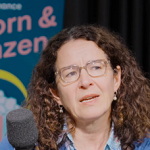
In the latest episode of the PostFinance podcast “Popcorn and Finances”, Sabine Döbeli (SSF CEO) discusses with Ivo Mugglin (PostFinance) why sustainable investing is a continuous process rather than a fixed goal.
|
| |
|
|
|
| |
| |
|
SSF-Article in "Nachhaltiges Investment"
|
| |
|
Romain Leroy-Castillo, Director AI and Education at SSF, wrote an article for "Nachhaltiges Investment" that went online in late January. He writes about the intersection of AI and sustainable finance, opportunities and limitations. Read the article here.
|
| |
|
|
|
| |
|
|
| |
| |
| |
|
Regulatory and market news
|
| |
|
| |
|
Swiss News
-
On 8 March 2026, the Swiss electorate will vote on the “Climate Funds” initiative. It intends that 0.5% - 1% (≈ CHF 3.9 - 7.9 billion) of the Swiss GDP should be invested in the ecological transformation thereby protecting climate and nature. The initiative foresees investments in sustainable energies, protection of biodiversity, or energy efficiency of buildings.
European News
- The European Union adopts the first ever standard for Carbon Removal Projects. It specifies the Carbon Farming and Carbon Removals (CRCF) Regulation that has been in place since 2024. The new set of rules covers three types of carbon removal, defines how to measure the removals, and how permanence is ensured.
- The European Central Bank has strengthened its climate risk analysis by improving key data and indicators used to monitor climate-related financial risks. The update includes more detailed tracking of sustainable finance instruments and refined carbon intensity measures, as well as enhanced modelling of physical risks such as windstorms. These model improvements have led to higher estimated potential losses for euro area bank loan portfolios and will support future supervisory and policy decisions.
- The Financial Conduct Authority (FCA) has proposed that listed companies in the UK will be required to report on sustainability matters starting with the 2027 reporting period. This contains climate reporting, transition plans, and the clarification over the assurance of their disclosures. Scope 3 emissions will be included as of 2028 on a “comply-or-explain” basis.
- France unveiled its third national climate adaption plan which is designed to assess risks in case of a 4-degree temperature increase by 2100. It prioritizes measures to protect coastlines, mountains, forests and agriculture. The government emphasizes that the plan is not a substitution but a complement to the net-zero strategy.
International News
Market News
- Towards the end of 2025 a sharp increase in investments in European ESG-ETFs was noted. Net inflows worth USD 13.2 billion in October 2025 account for the second highest inflows since beginning of measurements. Sustainable investments have outperformed traditional indices lately implying a financial rationale causing the shift.
- Mirjam Staub-Bisang, SSF board member, was elected to be Chair of the Board of Directors at SIFEM by the the Federal Council. The former Country Head of BlackRock Switzerland, AMAS Board member and trustee of the World Economic Forum’s Forum of Young Global Leaders will take up her role on 1 June 2026.
- The SDG Impact Finance Initiative (SIFI) has launched an open call for proposals to scale investable solutions for water and ocean resilience. The new call invites impact fund managers to submit commercially viable, market-driven solutions that strengthen water resources, marine ecosystems, and climate resilience in developing countries.
|
|
| |
|
| |
| |
|
Upcoming sustainable finance events
|
| |
|
|
|
|
|
|
|
|
|
|
|
|
|
|
| |
|
State of Finance for Nature 2026
|
| |
|
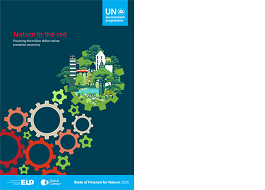
The UNEP’s State of Finance for Nature 2026 introduces the Nature Transition X-Curve. It is a conceptual framework based on transition pathways setting the direction towards a nature positive economy. At the moment, USD 7.3 trillion of nature negative capital must be reallocated in activities with nature positive outcomes. To put it in perspective, for every USD flowing into nature positive economic activities more than USD 30 flow into nature negative activities. The paper stresses that without a balanced ecosystem every economic activity will be harmed. It considers the private sector, the public sector, and policy makers and suggests according recommendations.
|
|
More >
|
| |
|
| |
|
Guidance on Integrating Deforestation into Net Zero Strategies
|
| |
|
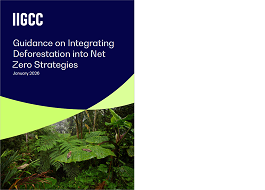
IIGCC’s new guidance is designed as a complement to the Net Zero Investment Framework (NZIF). It can be seen as a toolkit for investors to develop their individual net-zero strategy. It supports investors to identify and act on material risks. Regarding deforestation the recognition can vary depending on the geography of the investment. The starting point contains of 5 actions: assessing exposure, developing a deforestation policy, integrating considerations of deforestation and associated risks into investment decision-making, addressing material exposure to deforestation and associated risks through portfolio stewardship, and conducting systems-level stewardship by advocating for regulation and policies that aim to curb deforestation globally and scale deforestation- and conversion-free supply chains.
|
|
More >
|
| |
|
|
|
| |
|
Working Paper from WRI: AI for Nature: How AI Can Democratize and Scale Action on Nature
|
| |
|
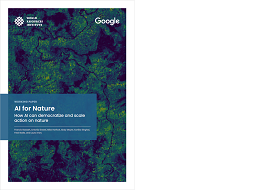
The report of the World Resources Institute and Google builds upon the contrary developments of artificial intelligence (AI) and biodiversity. 22 expert interviews as well as several case studies and research in the field point out how AI could potentially accelerate nature action. The paper examines various sectors and geographical areas. A key conclusion is that nature data must be produced at a higher scale and speed. In order to make better informed decisions it is essential that the information is democratized. AI can be a catalyst for this development since it is able to process and structure large amounts of data. The paper advocates a collective approach consisting of sharing knowledge and data.
|
|
More >
|
| |
|
| |
|
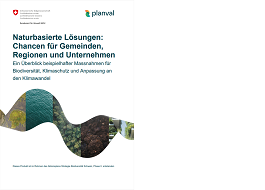
Naturbasierte Lösungen: Chancen für Gemeinden, Regionen und Unternehmen
|
| |
|
Published by the Swiss Federal Office for the Environment (FOEN) and planval, this new best-practice booklet offers a clear and practical overview of nature-based solutions in Switzerland. It presents 23 well-researched and evaluated examples across key ecosystems, highlighting their benefits for biodiversity and climate action. The publication serves as a valuable source of inspiration and guidance for municipalities, regions, and companies seeking to implement effective, integrated solutions.
|
|
More >
|
| |
|
|
| |
|
Would you like to find out more about recent developments in sustainable finance and members-only SSF activities? SSF members receive access to additional resources. Join our growing community to profit from it.
|
|
| |
|
| |
|
Kind regards
The SSF Team
|
| |
|
|
|
| |
|
|
| |
|
SWISS SUSTAINABLE FINANCE
|
|
|
| |
|
|
| |
|
|
| |
|
|
| |
|
|
| |
|
|
| |