| |
|
|
| |
|
|
| |
|
SSF Newsletter March 2026
|
| |
|
Resilience Drives Competitiveness
|
| |
|
Dear Reader
|
| |
|
As climate shocks, geopolitical tensions, and rapid technological change reshape the global economy, competitiveness increasingly depends on resilience and the ability of companies and investors to plan and act with confidence. Sustainable finance is central, not optional, for successful business strategies and supporting policy frameworks. It strengthens risk management, boosts transparency, and supports transition investments. Based on this, companies, nations, and economic regions reinforce their resilience and long-term competitiveness.
The EU’s Omnibus I Package (Official Journal, 26 February 2026) reduces administrative burdens and reporting obligations, exempting around 80% of originally affected companies. From a practical point of view, the simplification of overly complex and burdensome requirements was key. However, in efforts to promote competitiveness, not enough consideration was given to why sustainability transparency matters and which reporting simplifications genuinely support it.
In Switzerland, a similar debate lies ahead. Upcoming Federal Council consultations on reporting obligations and the counterproposal to the Corporate Responsibility Initiative 2.0 will reveal whether market actors view sustainability and resilience as integral to long-term business success.
I look forward to discussions on how to advance future competitiveness.
|
|
| |
|
|
Kind regards,
Katja Brunner
Director Legal & Regulatory, SSF
|
| |
|
|
|
| |
|
|
|
|
| |
| |
|
SSF activities at a glance
|
| |
|
| |
|
vps.epas Webinar "Fokus Pensionskassen"
|
| |
|
On 17 March 2026 Romain Leroy-Castillo, Director Education & AI, contributed to a Webinar on performance in the series "Fokus Pensionskassen" organized by vps.epas. More than 80 people were following the webinar that included an active debate. Read more.
|
| |
|
|
|
| |
| |
|
SSF Member Webinar: Introduction to the TISFD and implications for Swiss financial institutions
|
| |
|
On 10 March, around 50 SSF-members attended the webinar on the Taskforce on Inequality and Social-related Financial Disclosures (TISFD). Besides introducing the TISFD to our members, we also heard from two practitioners who shared their perspective based on their respective involvement with the TISFD. Read more.
|
| |
|
|
|
| |
| |
|
SSF Event: SSF/PRI Asset Owner Workshop on Impact Investing and Fiduciary duty
|
| |
|
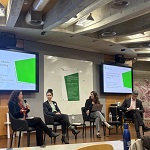
On 3 March 2026, Swiss Sustainable Finance (SSF) and the Principles for Responsible Investment (PRI) welcomed a group of dedicated asset owners for a joint workshop in Zurich. After a global policy outlook from PRI and a Swiss regulatory perspective from SSF, inputs by Martin Roth, President of ASIP, and two practitioners set the tone for an exchange between peers. Read more.
|
| |
|
|
|
| |
| |
|
Sabine Döbeli the DGNB Congress 2026
|
| |
|
At the annual conference of Deutsche Gesellschaft für Nachhaltiges Bauen (DGNB) Sabine Döbeli, CEO at SSF, presented insights of the Swiss Sustainable Lending Market Study 2025. Read more.
|
| |
|
|
|
| |
| |
|
SSF Webinar "EU Omnibus Package I: Practical Insights for Swiss Companies"
|
| |
|
On 19 February 2026, nearly 100 participants joined our webinar on the European Union’s Omnibus I package and its implications for Swiss companies operating in or with the EU market. Read more.
|
| |
|
|
|
| |
| |
|
Sabine Döbeli at Banking on Climate Action: The role of Banks in the Climate Crisis
|
| |
|
Sabine Döbeli, CEO at SSF, was invited as a speaker to the launch symposium of climateB at the University of St. Gallen, focussing on the topic of “Banking on Climate Action: The Role of Banks in the Climate Crisis”. Read more.
|
| |
|
|
|
| |
|
|
| |
| |
| |
|
Regulatory and market news
|
| |
|
| |
|
Swiss News
European News
Market News
|
|
| |
|
|
|
|
|
| |
| |
|
Artificial Intelligence (AI) in Sustainable Finance
|
| |
|
| |
- New use case: We added to our dedicated online page a new use case of Artificial Intelligence: “Geospatial intelligence to assess climate, environmental and supply chain risks” by MSCI. This use case shows how to use AI to identify assets, classify their activities, locate them accurately, capture physical attributes (e.g. footprint, height, value), and link them to corporate and supply-chain structures. Purpose is to translate climate and sustainability risks into actionable portfolio insights
- The University of Zurich (UZH) and the Zurich University of Applied Sciences (ZHAW) are currently conducting an industry survey on the potential of “AI and Digital Assets for Sustainable Finance”. The survey can be accessed here.
|
|
| |
|
| |
| |
|
Upcoming sustainable finance events
|
| |
|
|
|
|
|
|
|
|
|
|
|
|
|
|
| |
|
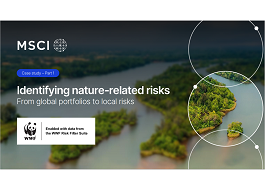
Identifying nature-related risks - From global portfolios to local risks
|
| |
|
MSCI and WWF have published a case study that demonstrates that nature risk is financially material. Thanks to a new metric developed by the two institutions several correlations could be examined. At a company level risk exposure can be quantified and directly attributed to revenue streams. At market portfolio or sector level an aggregated picture can be drawn highlighting the amounts exposed to pollution. Due to the low EBITDA margins, there might not be a lot of room to react to these risks as they materialize.
|
|
More >
|
| |
|
| |
|
Climate change and systemic risk: Evidence from financial intermediaries
|
| |
|
The study by Pellegrini, C. B., Pellegrini, L., & Vismara, S. examines how climate change, specifically temperature deviations from historical averages, affects systemic risk in the banking sector by analysing 35 financial intermediaries across 13 countries using the ΔCoVaR methodology. It finds that increased temperature volatility is linked to higher systemic risk, amplifying credit risk and reducing lending capacity, and suggests that incorporating climate variables into financial risk models is essential for policymakers and risk managers to safeguard financial stability in a warming world.
|
|
More >
|
| |
|
|
|
| |
|
Mapping climate-related metrics in the financial sector
|
| |
|
OECD published a paper highlighting the obstacles to overcome in order to be able to reliably report on climate and set net-zero paths. Lack of data, variation of methodologies, and different levels of granularity are only a selection. The aim of the paper is to propose a framework fostering transparency, comparability, and credibility of the disclosed climate data.
|
|
More >
|
| |
|
| |
|
The evolving landscape of ESG ratings and data products
|
| |
|
The International Capital Market Association (ICMA) provides an overview of the ESG ratings and data products ecosystem. According to the publication assets valued at USD 28 trillion have according ESG ratings. It examines the broad selection of the underlying ratings and methodologies, that lead to initiatives that advocate for regulation to ensure transparency. From these discussions voluntary initiatives and best practices have formed.
|
|
More >
|
| |
|
|
| |
|
Would you like to find out more about recent developments in sustainable finance and members-only SSF activities? SSF members receive access to additional resources. Join our large community to profit from it.
|
|
| |
|
| |
|
Kind regards
The SSF Team
|
| |
|
|
|
| |
|
|
| |
|
SWISS SUSTAINABLE FINANCE
|
|
|
| |
|
|
| |
|
|
| |
|
|
| |
|
|
| |
|
|
| |