| |
|
|
| |
|
|
| |
|
SSF Newsletter June 2026
|
| |
|
Charting New Waters
|
| |
|
Dear Reader
|
| |
|
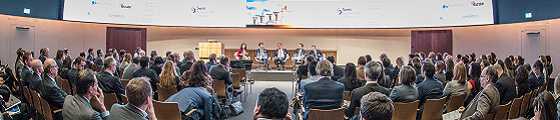
On 18 June, we gathered in Bern with the Swiss sustainable finance community to explore innovative solutions at our SSF Annual Conference. It was great to see so many of you there!
What stood out? Our keynote speaker and panellists – spanning diverse sectors – shared a common spirit:
- a curiosity to push boundaries,
- a sense of urgency for change,
- and the ability to communicate complex ideas accessibly.
No one cited lack of expertise or energy as a barrier to scale innovative and sustainable technologies.
Yet, Swiss startups keep facing challenges in finding the necessary funding to grow their business. Despite abundant creativity and proven concepts, investors' hesitation to invest systematically into startups and help them scale persists – whether in cleaning polluted sites or expanding EV-charging infrastructure, to name a few examples presented by our panellists.
I’m convinced the Swiss financial market is well equipped to drive innovation for a sustainable future forward through specialised financing and investment products. As an association of 250+ committed members ranging across all segments of the financial sector we’re dedicated to uniting this knowledge, and drive innovation forward. Our packed agenda for the second half of this year is proof of this.
Would you like to join us? I look forward to our next gathering of like-minded pioneers, ready to chart new waters together.
|
|
| |
|
|
Kind regards,
Jacqueline Etter
Lead Communications and Member Relations
|
| |
|
|
|
| |
|
|
|
|
| |
| |
|
SSF activities at a glance
|
| |
|
| |
|
SSF Annual Conference 2026: Innovating for a Sustainable Future
|
| |
|
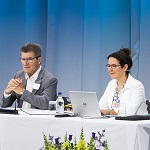
On 18 June 2026, we hosted the SSF Annual Conference 2026 at Kursaal in Bern which shed light on the role of AI for sustainability and sustainable finance. Start-ups and scale-ups then presented their innovative technologies, showcasing how they help shape the future of agriculture. Finance experts explained how capital is allocated to emerging technologies, enabling them to scale their business. Read more
|
| |
|
|
|
| |
| |
|
SSF Members' Assembly 2026 with elections
|
| |
|
At this year's Members' Assembly Fiona Frick (SFG & Circe Invest), and Dominique Becht (Stiftung Abendrot) stepped down from their roles as board members as their third term came to an end. They are succeeded by Christine Schmid (Servisa) and Virginie van Doorn (SFG), who were unanimously elected by the SSF Members. See SSF Board
|
| |
|
|
|
| |
| |
|
Launch Webinar – Swiss Sustainable Investment Market Study 2026
|
| |
|
On 9 June, we published the Swiss Sustainable Investment Market Study 2026 and provided first insights during our launch webinar with an audience of over 200. Romain Leroy-Castillo (SSF) led through the study and Katja Brunner (SSF) gave a regulatory update before Ivo Mugglin-Moser (PostFinance) and Markus Stierli (Vontobel) debated the findings in a panel discussion moderated by Sabine Döbeli (SSF). Read more
|
| |
|
|
|
| |
| |
|
Sustainable Real Estate Roundtable – Net-Zero for Building Portfolios
|
| |
|
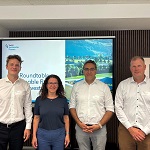
A group of around twenty members joined this roundtable on June 2 to examine pathways for achieving net zero across a real estate portfolio. Sabine Döbeli (SSF) and Nicola Waefler (SSF) led through the event in which Florian Landolt (Minergie) and Rafik Awad (Swisscanto) provided inputs. Read more
|
| |
|
|
|
| |
| |
|
Sustainable Financing Roundtable – Managing Climate Risks in SME Lending
|
| |
|
The roundtable took place on 11 June in Zurich and SSF invited exponents from banks to talk about transition strategies regarding their business with SMEs. Mischa Aeschlimann (Migros Bank), Nicole Saunier (BHP), Andreas Holzer (BLKB), and Veronica Baker (SSF) gave short presentations as a basis for the lively discussions. Read more
|
| |
|
|
|
| |
|
|
| |
| |
| |
|
Regulatory and market news
|
| |
|
| |
|
Swiss News
European News
International News
Market News
|
|
| |
|
| |
| |
|
New SSF members and network partners
|
| |
|
| |
|
We are happy to welcome the following organisation as new SSF network partner:
The full list of our members and network partners, now standing at 253 can be found here.
|
|
| |
|
| |
| |
|
Artificial Intelligence (AI) in Sustainable Finance
|
| |
|
| |
- Latest research by Aysun Can Turetken and Markus Leippold shows how leading financial sentiment models can be manipulated by human-imperceptible textual changes. This highlights the vulnerability of automated trading based on financial sentiment analysis.
- Frontier, a coalition for carbon removal technology, increased the funding by an additional USD 915 million, reaching USD 1.8 billion. Athtropic is the latest member of the coalition formed of Big Tech companies. The initiative aims to support the scaling and development of carbon removal technologies through investment commitments in high-quality carbon credits.
|
|
| |
|
| |
| |
|
Upcoming sustainable finance events
|
| |
|
|
|
|
|
|
|
|
|

|
| |
|
Schweizer Pensionskassenstudie 2026
|
| |
|
The Schweizer Pensionskassenstudie 2026 published by Swisscanto shows positive results. In 2025 both public and private schemes reached historically high funding ratios, combined with exceptionally high average returns of 4.7%, the highest interest rate credited since 2000. ESG criteria embedded in the investment regulations of Swiss pension funds remain stable at around one third, up from 8% in 2015. Progress on sustainability initiatives has stalled, with 35% of funds measuring portfolio emissions and 14% setting CO₂ reduction targets. However, there is little evidence of reversal: only 1% of funds have relaxed their ESG requirements, while 2% have made them more stringent.
|
|
More >
|
| |

|
| |
|
Annual Report on the 2026 Proxy Season
|
| |
|
The latest AGM report by the Ethos Foundation, covering 172 Swiss listed companies, shows mixed progress. Women now hold 30.4% of SPI board seats (up from 28.8% in 2025), but 78 companies remain below the 30% threshold and 22 boards still have no female members. At SMI companies, average CEO pay has risen 28.8% over five years to CHF 8.8 million, with eight CEOs earning more than CHF 10 million. At the same time renumeration reports on average only get approved by 87.5% of the AGM making it the most contentious agenda item. Sustainability reporting also remains a challenge: Ethos recommended approval for only 36.7% of reports, and 53 companies still lack external verification of non-financial data. One positive trend is the rise in binding votes on sustainability reports, from 54.1% in 2024 to 65.9% in 2026.
|
|
More >
|
| |
|
|
|
| |
|
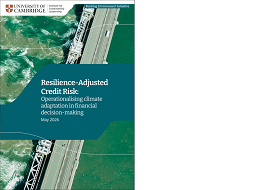
Resilience-Adjusted Credit Risk: Operationalising climate adaptation in financial decision-making
|
| |
|
The Cambridge Institute for Sustainability Leadership (CISL) analyses how credit risk approaches are evolving in response to physical climate risks, including insurance adequacy and investments in adaptation and resilience. This work has led to the RACR framework, which provides guidance for risk managers on how to properly account for these structural risks. Between 2015 and 2024, climate-related damage increased by 134% compared with 2000, while many risk frameworks still rely heavily on historical data. As a result, physical climate risks are accumulating much faster than they are being priced in, potentially directing capital flows into assets that may become stranded.
|
|
More >
|
| |
|
| |
|
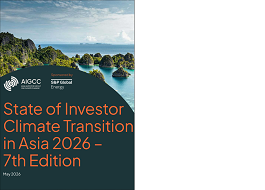
State of Investor Climate Transition in Asia 2026
|
| |
|
The Asia Investor Group on Climate Change finds that investor climate action in Asia has evolved over the past seven years across three phases, based on a review of 240 asset owners and managers and a survey of 59 respondents. The focus is shifting from early-stage disclosure and frameworks such as NZIF, SBTi, and ISSB, through a phase of heightened scrutiny over “greenwashing,” to today’s implementation phase. The group also finds that 45% of respondents report that barriers to climate investing have improved over the past 12 months, despite continued global geopolitical uncertainty. Investors are now moving beyond commitments toward credible transition plans, portfolio-level action, and active stewardship, rather than exclusion or divestment strategies.
|
|
More >
|
| |
|
|
|
| |
|
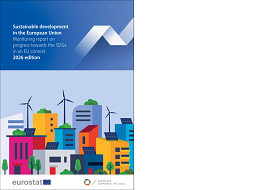
Monitoring report on progress towards the SDGs in an EU context 2026
|
| |
|
Eurostat published their yearly update on the progress towards the SDGs on 3 June 2026. It carefully analyses all the 17 SDGs and rates the progress made. The EU continues to make steady progress toward the Sustainable Development Goals, with significant improvements in 5 of the 17 SDGs over the past five years, including decent work and economic growth (SDG 8), reduced inequalities (SDG 10), and quality education (SDG 4). At the same time, 9 additional goals show moderate progress, with especially strong gains in industry, innovation and infrastructure (SDG 9) and zero hunger (SDG 2). However, the picture is uneven: 3 SDGs show no progress or even deterioration, including life below water (SDG 14) and life on land (SDG 15), reflecting ongoing environmental pressures.
|
|
More >
|
| |
|
|
| |
|
Would you like to find out more about recent developments in sustainable finance and members-only SSF activities? SSF members receive access to additional resources. Join our large community to profit from it.
|
|
| |
|
| |
|
Kind regards
The SSF Team
|
| |
|
|
|
| |
|
|
| |
|
SWISS SUSTAINABLE FINANCE
|
|
|
| |
|
|
| |
|
|
| |
|
|
| |
|
|
| |
|
|
| | |