Real-Time Market Intelligence for Swiss Real Estate

Challenge to overcome
Real estate is the largest asset class operating without market-wide transparency. In Switzerland, data on buildings and investment vehicles is scattered across annual reports, PDFs, and proprietary databases. No unified view exists for comparing assets at scale or assessing ESG risks across portfolios.
This opacity distorts prices, leaves climate exposure unpriced, and directs capital without visibility into what it funds, following the well-know principle: what does not get measured cannot be managed.
AI / ML solution
QuanthomeAI strives to address this issue by connecting users to a unified database through natural language queries.
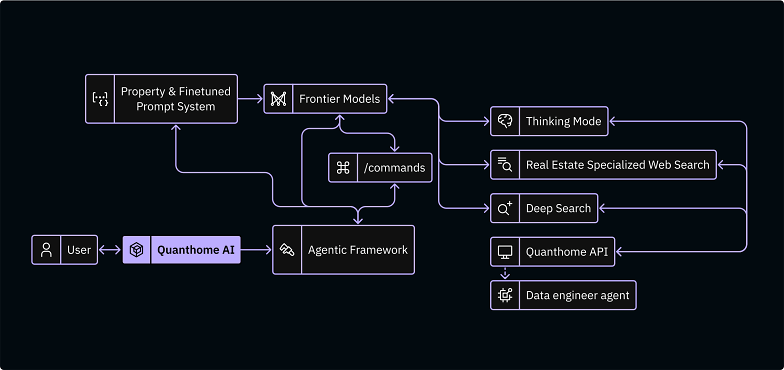
The system connects to a proprietary database covering all Swiss buildings and over 150 investment vehicles, linking physical assets to the portfolios that hold them. Users are able query ESG metrics, financial performance, risk exposure, and market comparisons in natural language. An agentic framework allows the AI to iterate and self-correct, while domain-specific prompts reduce hallucination and maximize relevance. The above solutions allows to address different dimensions of the challenge described above:
- Improves price discovery. Market-wide data access reduces information asymmetry. Risks get priced more accurately, and ESG mispricing begins to correct.
- Supports faster execution. Instant access to building permits, renovation status, comparables, and ESG signals accelerates underwriting across assets and vehicles.
- Allows for ESG integration. Climate risk, CO₂ exposure, and energy performance become visible and comparable across portfolios, supporting decision-making.
- Fosters democratization. Institutional-grade insights at accessible prices narrow the gap between large and small investors.

Use case key beneficiaries
☒ Relationship Managers
☒ Portfolio Managers
☒ Research teams, macroeconomists
☒ Control functions
☒ Support functions (HR, CFO, …)
☒ Other: Advisors, auditors
Benefits of AI use case for financial services industry
In a similar manner as Bloomberg did for securities, Quanthome strives to build the data infrastructure for real estate to become measurable and comparable. By creating market-wide transparency from fragmented real estate data, it increases the accuracy in price discovery, allows for faster and lower-cost investment decisions, and systematic integration of ESG and climate risks across portfolios. It also democratizes access to high-quality insights, ensuring capital is allocated with better visibility into risks, sustainability impact, and asset value.
Supporting technology
- Data ingestion. The platform ingests structured data (financials, ESG metrics, building attributes) and live news through API calls. A scalable Retrieval-Augmented-Generation system is under development to integrate unstructured sources such as annual reports.
- Proprietary ML pipelines. Valuations, rent levels, and CO₂ emissions are modeled using hybrid techniques including Lasso regression, gradient boosting, and random forest algorithms. These power the structured database that Quanthome AI queries in real time.
- LLM integration. Users interact with the database through a conversational interface. Questions asked in natural language are interpreted by the LLM, which translates them into structured queries, retrieves relevant data, and returns answers in readable formats. The system can generate reports, tables, or comparisons depending on user needs. Users access Claude 4.5 (Opus, Sonnet, Haiku) and Gemini 3.0, selecting models based on task complexity.
- Agentic framework. Unlike traditional chatbots that respond in a single pass, the agentic framework operates through an iterative loop. The AI calls APIs, executes code, retrieves data, and validates outputs before responding. If results are incomplete or inconsistent, it identifies the gap and re-executes automatically. This enables complex analytical workflows without manual intervention.